
Call Now for 24/7 Emergency Repairs(984) 271-2113
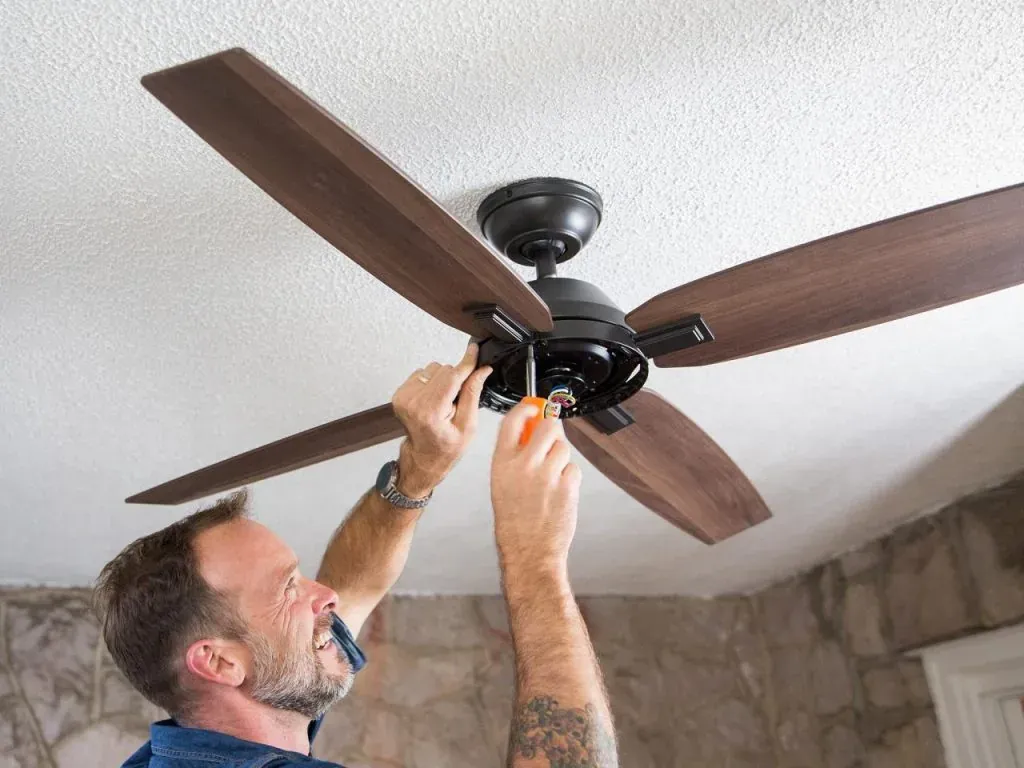
Electrician wiring the motor of a new ceiling fan with dark wood blades

Durham Ceiling Fan Installation That Runs Quiet and Stays Put

Hanging a new fan, or swapping a light for one? Brian Electric LLC installs ceiling fans in homes across Durham and nearby towns. We check the ceiling box and the wiring first, so your fan runs safe and quiet with no wobble.

  • Licensed in North Carolina
  • Fan-rated box checked first
  • Permits handled for new wiring
Call Now · (984) 271-2113

Pick Your Project

What Kind of Fan Job Do You Have?

Every ceiling fan installation in Durham starts with one question: what is in your ceiling right now? Pick the job that sounds like yours to see what it takes.

Swapping an Old Fan for a New One

This is the simplest job, since the wiring and the box are already in place. Still, many fans hung years ago sit on a box made for a light, not a fan. A heavier new fan on that box can start to wobble or work loose.

What we check

  • How the box is fixed to the ceiling joist
  • The weight rating on the box
  • The condition of the old wires

Good to know: Keep the box and manual from your new fan. The weight and wiring notes help us plan.

Putting a Fan Where a Light Hangs Now

This is the job we do most. A box built for a light is often too weak for a fan. A fan weighs more, and it moves every time it runs. We take out the old box and put in a fan-rated box with a brace between the joists.

What we check

  • Whether the box is fan-rated
  • Room for a brace above the ceiling
  • One wall switch or two

Good to know: Want the fan and the light on separate switches? That often needs one more wire, so tell us when you call.

Adding a Fan Where There Is No Wiring

No light in that spot? We run new wire from a nearby circuit, add a fan-rated box and put a switch on the wall. Most of the time the wire goes through the attic. A room with no attic above may need small openings in the drywall. We show you where before we start.

What we check

  • Room on the circuit for the fan
  • The best path for the new wire
  • Attic access above the room

Good to know: New wiring can need a permit. We pull the permit and set up the inspection for you.

High, Sloped and Vaulted Ceilings

A tall or slanted ceiling changes how the fan hangs. A high ceiling needs a longer downrod so the air reaches you. A steep slope needs an angled mount so the blades clear the ceiling and the fan hangs straight.

What we check

  • Ceiling height at the fan spot
  • The angle of the slope
  • Downrod length and mount type

Good to know: Tell us the ceiling height when you call. We bring the right ladder and the right parts.

Porch and Patio Fans

Durham summers are hot and humid, and a porch fan helps a lot. But an indoor fan outside can rust and fail fast. A covered porch needs a damp-rated fan. A spot where rain hits the fan, like a pergola or an open deck, needs a wet-rated one.

What we check

  • The rating on the fan label
  • A box and cover made for outdoor use
  • How the wire gets to the porch ceiling

Good to know: Not sure which rating you need? Send us a photo of the spot and we will tell you.

Drawing of a ceiling fan held by a fan-rated box on a brace between two ceiling joistsAtticPowerCeiling7 ft or more1234

Safety First

The Box Above Your Fan Matters Most

A ceiling fan can weigh 15 to 50 pounds, and it shakes a little every time it spins. Most fan problems we see in Durham start with the box it hangs from, not the fan itself. Here is what holds a fan up the right way.

  1. Brace between the joists

    A metal brace spans two ceiling joists and holds the box. It takes the weight and the shake when the fan runs.

  2. Fan-rated box

    It is marked "Acceptable for fan support." Most are rated for fans up to 70 pounds. A plain light box is not made for a load that moves.

  3. Mounting bracket

    It screws to the box with the screws made for it, so the fan cannot work loose over time.

  4. Downrod and canopy

    The downrod sets how low the fan hangs. Most fan makers ask for the blades to sit at least 7 feet above the floor.

How We Check What Is in Your Ceiling

  1. We turn off the power at the breaker and test the wires.
  2. We take down the old fixture and read the label inside the box.
  3. We see how the box is held: by a joist, a brace, or only the drywall.
  4. We look at the wires, the ground and how much is on the circuit.
  5. You hear what we found and get a price before any work starts.

Older Durham Homes: Plaster Ceilings and Old Boxes

Many Durham homes were built between the 1920s and the 1960s. Their ceilings often hide a few surprises:

  • Plaster and lath. It cracks if it is cut the wrong way, so the opening has to be made with care.
  • Shallow or nailed boxes. Some old boxes are only nailed to the lath, with nothing solid behind them.
  • Cloth-covered wire. It gets brittle near old light fixtures, and it often has no ground wire.

Read more about the homes in Duke Park and Hayti.

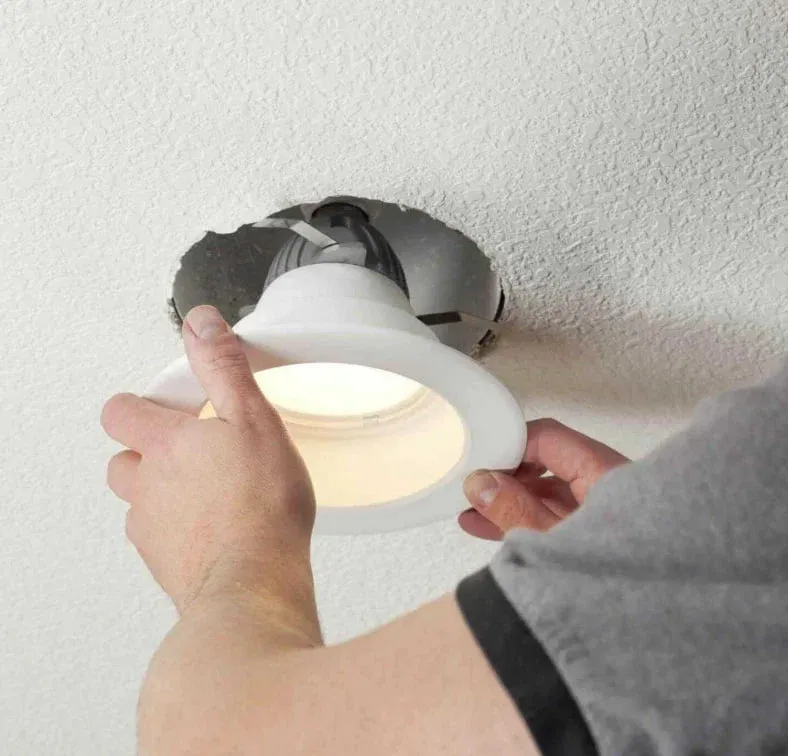
Electrician fitting a light into a round opening in the ceiling

Before You Buy

Picking the Right Fan for the Room

A fan that is too small for the room barely moves the air. One that hangs too high cools the ceiling, not you. These three charts cover what to look at before you buy a fan for your Durham home.

Already have a fan in mind? Send us the model number. We will tell you if it fits the room and the ceiling.

Blade Size by Room Size

  • Up to 75 sq ftBathroom, laundry room
    29 to 36 in
  • 76 to 144 sq ftBedroom up to 12 x 12
    36 to 42 in
  • 144 to 225 sq ftLarge bedroom, kitchen
    44 to 50 in
  • 225 to 400 sq ftLiving room, den
    50 to 54 in
  • Over 400 sq ftGreat room, open plan
    56 in or more, or two fans

Downrod Length by Ceiling Height

CeilingDownrod
8 ftFlush mount
9 ft6 in
10 ft12 in
11 ft18 in
12 ft24 in
13 ft36 in
14 ft48 in

Sloped ceiling? Measure at the spot where the fan will hang.

Indoor, Damp or Wet Rated

  • Dry
    Bedrooms, living rooms, kitchens

    Any room inside the house that stays dry.

  • Damp
    Covered porches, bathrooms, laundry rooms

    Handles humid air, but not rain hitting the fan.

  • Wet
    Pergolas, open decks, porch edges

    Built for rain and hose spray. Look for "wet" on the label.

Fan Controls

Wall Switch, Remote or Smart Control

How you turn the fan on matters as much as the fan. Decide before install day, since some controls need an extra wire run to the switch.

Wall Switch

A switch or a fan speed control on the wall. Simple, and always where you expect it.

Best for
Bedrooms and living rooms you use every day.
New wiring needed? Sometimes
Not if a switch already runs the light. Separate fan and light switches can need one more wire.

Good to knowDo not use a light dimmer on the fan motor. It can make the fan hum and wear the motor out. Use a control made for fans.

Remote Control

A small receiver goes inside the fan canopy. A hand remote sets the speed and the light.

Best for
High ceilings, and rooms where the switch is far from the bed or couch.
New wiring needed? No
The receiver uses the wires already at the fan.

Good to knowLeave the wall switch on. If it is off, the remote has no power to work with.

Smart Control

A smart wall control or a smart fan that runs from your phone, a voice assistant or a schedule.

Best for
Homes that already use a smart home app.
New wiring needed? Often
Most smart wall controls need a neutral wire in the switch box. Many older Durham homes do not have one there.

Good to knowPick one smart part, not two. A smart fan works best with a plain on and off switch.

Install Day

What Happens on Install Day

No guessing about what comes next. Here is how a ceiling fan install goes, from the moment we walk in to the moment the fan spins.

  1. 01

    Quick Look

    We look at the spot, the switch and the fan you picked. You confirm where it hangs.

  2. 02

    Power Off

    We shut off the breaker, test the wires and take down the old fan or light.

  3. 03

    Box and Brace

    If the box is not fan-rated, it comes out. A brace and a fan-rated box go in.

  4. 04

    Mount and Wire

    The bracket, downrod and motor go up. The wires are joined and the ground is connected.

  5. 05

    Balance and Test

    We hang the blades, run every speed and fix any wobble before we call it done.

  6. 06

    Clean Up

    We clean the work area and show you the controls. New wiring gets its inspection set up.

Have these ready

  • The new fan in the room, still in its box
  • A clear floor under the fan spot
  • A clear path to the attic, if there is one

Pricing

What Changes the Cost of a Fan Install

There is no single price for ceiling fan installation in Durham, NC. A simple swap costs much less than a fan in a spot with no wiring. This scale shows where your job likely falls.

  1. Fan Swap

    New fan on a box that is already fan-rated.

  2. Light to Fan

    Old light box out, brace and fan-rated box in.

  3. High or Sloped Ceiling

    Longer downrod, angled mount and taller ladders.

  4. Brand New Spot

    New wire, new box and a new wall switch.

Electrician holding wires and a tester while a homeowner waits in the living room

Five things that move the price

  • The box in your ceilingA fan-rated box that is already there saves time. A light box has to be replaced.
  • How the wire gets thereAn open attic above the room makes a new wire run much easier than a finished ceiling.
  • Ceiling height and slopeTall and slanted ceilings take more time, more parts and bigger ladders.
  • Controls you wantA separate switch for the fan and the light, or a smart control, can need an extra wire.
  • How many fansMore fans take more time, but they all share one trip and one setup.

Tell us the room, the ceiling height and what hangs there now. Send a photo if you can. You get a clear price before any work starts.

Call for a Free Estimate

Fan Wobbling, Humming or Not Spinning?

Not every fan needs to be replaced. These are the usual causes we find.

  • It wobbles

    Often a loose blade, a bent blade arm or a box that is not fan-rated. A loose box is the one to fix fast.

  • It hums

    Often a light dimmer on the fan motor, a loose canopy or a remote receiver that has gone bad.

  • It will not spin

    Often a switch, a pull chain, a remote receiver or a worn part in the motor. Check the breaker first.

Burning smell or sparks from a fan? Turn it off at the breaker and call us. Our emergency electrician line is open 24/7.

Call (984) 271-2113

Customer Reviews

What Customers Say About Our Work

5.0

Read Our Google Reviews
  • Forrest B.Google review

    My wife and I can't say enough about Brian Electric. This was our third time hiring Brian to help with renovations. His work is exceptional and we are very impressed with his knowledge/quality of his work. We will definitely hire him again in the future!!

  • Bridget D.Google review

    Brian was amazing. He was able to come the same day I called. He was able to quickly diagnose and fix the problem. He was very informative and answered all of my questions. I will definitely recommend and will be using his services again.

  • Robert P.Google review

    Brian installed a Kitchen Light fixture over my Kitchen Island. He arrived on time, was very professional and had the experience and know-how to install what I would consider a difficult installation in a short amount of time.

  • Jackie V.Google review

    If I could give 10 stars I would. He was so helpful with my major project, and really looked out for my best interests. He even took on a spontaneous smaller project that popped up as he was finishing the larger one!

  • Robin L.Google review

    He came and installed a new light above our kitchen sink. Excellent work, prompt service and a truly good guy. What more could you ask for? We will definately call Brian for any work we may need in the future. I would highly recommend him to anyone in need of quality electrical work!

  • Barbara M.Google review

    Brian traced down our light and receptical outage. He made the repair in under an hour and had our home in working order again.

  • De K.Google review

    I cannot say enough good things about Brian Electric. He's corrected other marginal work and has completed all sorts of jobs in the past with excellent craftsmanship. I only wish there was more of Brian to go around!

  • Martin M.Google review

    Brian Electric has provided us with quality, on-time service for all of our electrical needs in the house we moved into a year ago.

  • Robby C.Google review

    Super professional! Great quality work with attention to detail. Highly recommend. This is my new go to electrical contractor!

  • Brandon S.Google review

    On time, professional and excellent quality work. Brian Electric is one of the best electricians we've worked with.

Service Area

Ceiling Fan Installation in Durham and the Triangle

We are based in Durham and install ceiling fans in homes all over the Triangle. Not sure if we come to your town? Call and ask.

Neighborhoods We Serve

View All Service Areas

FAQ

Ceiling Fan FAQs

Not sure what your fan needs? Call with the fan model and the ceiling height, and we will tell you what comes next.

Call (984) 271-2113

Can you install a ceiling fan I already bought?

Yes. When you call, share the model number and the ceiling height. We check that the box can hold it and that the downrod fits. Keep every part and the manual with the fan.

How long does a ceiling fan installation take?

A swap on a fan-rated box is usually a short visit. A fan in a new spot with new wire and a new switch takes longer. You get a time estimate along with the price.

Do I need a permit to install a ceiling fan in Durham?

Swapping one fan or light for another usually does not need one. New wiring or a new circuit often does. When a permit is needed, we pull it and set up the inspection.

Can a ceiling fan go on a sloped ceiling?

Yes. Most fans handle a gentle slope with the mount they come with. A steep slope needs an angled mount kit and often a longer downrod so the blades clear the ceiling.

Which way should my ceiling fan spin?

In summer, run it counterclockwise when you look up. That pushes air down on you. In winter, switch it to clockwise on low speed to move warm air off the ceiling.

Will a ceiling fan lower my power bill?

It can. A fan cools people, not the room, so you can set the thermostat a few degrees higher and still feel comfortable. Turn the fan off when you leave the room.

Call 24/7: (984) 271-2113